Paper Clip History Before the Desk Drawer
Paper clip history traces the shift from ties and pierced pages to a removable wire fastener, and shows what patent records can—and cannot—establish.
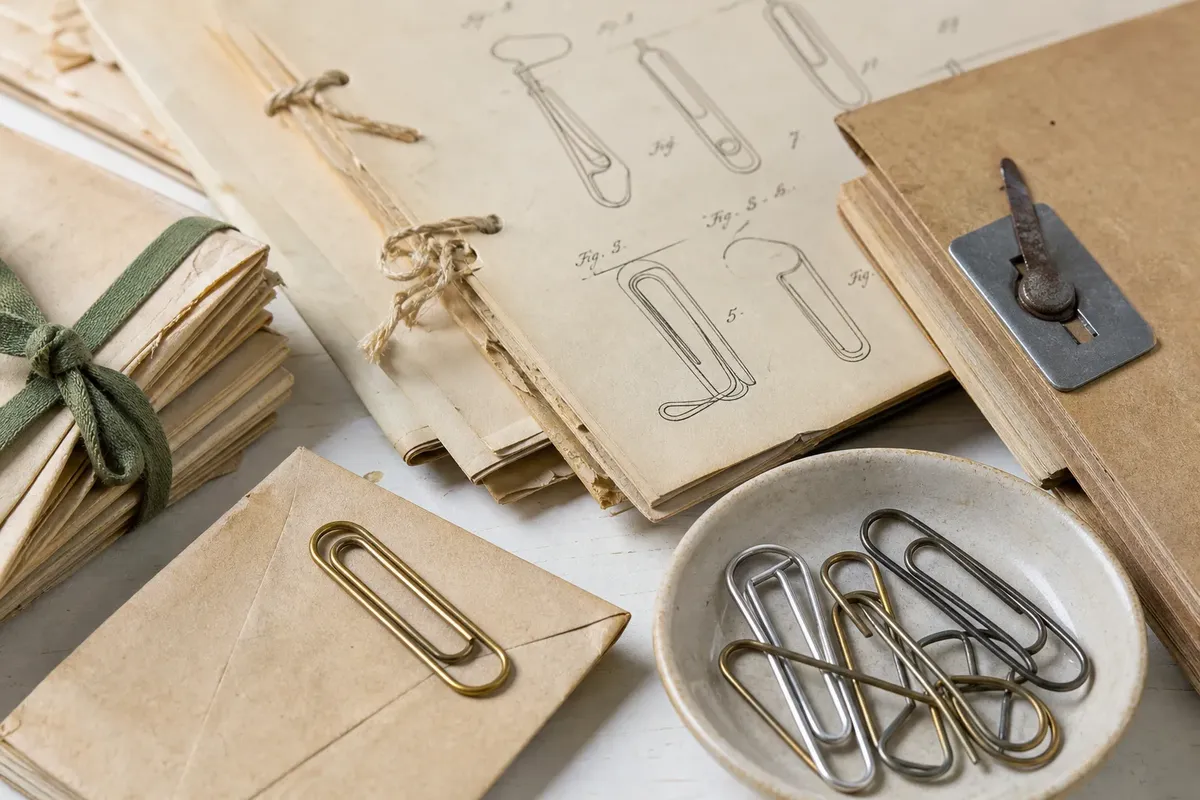
Paper clip history starts with a small inconvenience: loose sheets needed to stay together without being pierced or bound. The familiar bent-wire clip answered that need, but its path into everyday use is not a tidy story of one inventor and one decisive launch.
Patent records document several proposed paper fasteners, including nineteenth-century designs such as Samuel B. Fay’s paper clip patent and Erlman J. Wright’s paper-fastener patent. These records establish that particular proposals were patented; they do not show, by themselves, which design reached desks first or explain the unsettled origin of the familiar Gem-style outline.
What held loose papers before the paper clip?
People tied bundles with string or ribbon, pierced or stitched pages, and stored documents in folders or covers. These were different ways of managing papers, not a single routine followed by every office.
Tying secured a bundle, while stitching or piercing left a lasting mark. A folder kept papers together without necessarily making individual sheets easy to add or rearrange. A removable clip served a narrower purpose: holding a few loose pages while leaving them intact.
Why did paperwork leave room for a removable fastener?
Documents may need to be grouped, separated, or rearranged. A fastener that holds pages without making a hole suits a temporary grouping, though that general need does not prove it caused any particular invention.
Earlier paper fasteners also included clamps and more elaborate mechanisms. Patent records provide dated evidence that inventors proposed different designs, but a patent documents a claim and its filing history—not commercial success, widespread use, or priority over every unrecorded design.
How did the familiar bent-wire form emerge?
The familiar clip is made from one piece of wire bent into nested loops. Its outer curve slips over a page edge, and the inner section presses against the sheets; spring tension and friction provide a temporary grip.
The Gem-style form became strongly associated with the everyday paper clip, but its precise origin remains uncertain. “Gem-style” names a recognizable outline and product tradition; it does not identify the first person to devise that shape. Its simple construction may help explain its appeal, but that is not evidence of a particular maker’s motive.
Several designs and makers belong to the broader history of paper fasteners. The familiar outline became common through a commercial history that is less orderly than a single-inventor account suggests.
What do readers ask about paper clip history?
Who invented the paper clip?
No single inventor is securely established for the familiar paper clip. Patent records document multiple proposals, while the origin of the widely recognized Gem-style outline remains unsettled.
What came before the paper clip?
People tied bundles, pierced or stitched pages, and kept documents in covers. These methods met different needs and should not be treated as one universal office practice.
What does Gem-style mean?
Gem-style refers to a familiar bent-wire form with nested loops. The name is associated with a recognizable product tradition, but it does not settle who first created the shape.
How does a paper clip hold pages?
The bent wire presses against the paper’s edge and surfaces, using spring tension and friction to hold a small stack. The grip is temporary, and sheets can shift if the clip does not fit the stack.
How should you describe an old paper clip?
Shape alone cannot establish a clip’s age, maker, or place of manufacture. If you find one with documents, record visible details and preserve its association before drawing conclusions.
- Check the material and surface. If the material is identifiable, record it; if it is not, describe the color and visible condition without naming a metal.
- Check the form. If its loops resemble a Gem-style clip, describe the resemblance; if they differ, record the bends without assigning a maker.
- Check for marks or packaging. If a legible label or maker’s mark is present, record it; if neither is present, do not infer a brand from the outline.
- Check where the clip was found. If it remains with a letter or ledger, note that association before moving it; if it was loose, record that it was found loose.
- Check the surrounding papers. If the clip visibly holds pages together, record that relationship; if it is merely nearby, describe proximity rather than claiming it fastened them.
- Separate observation from inference. If a claim is directly visible, record it as an observation; if it interprets past use or ownership, label it as an inference or leave it open.
Imagine you find a brass-colored clip inside an envelope containing family correspondence. You photograph the clip beside the envelope, note its color and nested-loop shape, and record that it was stored there. Because it is not visibly attached to a letter, you describe the association without claiming it fastened the pages; the result preserves what can be seen while leaving its age and role undecided.
Is tracing every clip to an inventor useful?
Usually not. A familiar outline cannot identify a maker on its own, and forcing designs into a neat sequence can make uncertain evidence sound settled. A readable mark, original packaging, or reliable documentary record may support a more specific account; without one, a careful description is more useful than a confident guess.
The useful distinction in paper clip history is modest: unlike a stitch or puncture, a wire clip can hold a few intact sheets and come off when their arrangement changes. For an old clip, recording what is visible—and leaving the rest open—is often the soundest account the object can support.
Nearby questions

Why Honeycomb Cells Settle into Hexagons
Why honeycomb cells settle into hexagons involves geometry and bee construction. Learn what shared walls explain—and…

Borrowed Words: Keep the Spelling, Adapt the Sound
Borrowed words need not force a choice between sound and spelling. Keep a recognizable written form,…