Why an Object Label Can’t Tell the Whole Story
An object label gives only part of the story. Learn what labels can establish, where their wording falls short, and when you need another source.
“Push” is printed on a door whose handle invites a pull. That mismatch shows why an object label cannot tell the whole story: wording can direct or identify, but it cannot settle every question about an object’s design, history, or present use.
What can an object label establish?
A label can provide a name, a warning, a material claim, or an instruction. Its strongest contribution is usually narrow: it tells you what the label says, and sometimes who is speaking. A maker’s material mark, for instance, is not the same as a disposal instruction from a local collection service.
Labels also have limits of space and purpose. A tag on a tool may warn against a particular hazard without explaining the full procedure; a sticker on a container may identify its intended contents without saying whether someone has since reused it. The wording records a claim or direction, not every event in the object’s life.
Why can wording mislead?
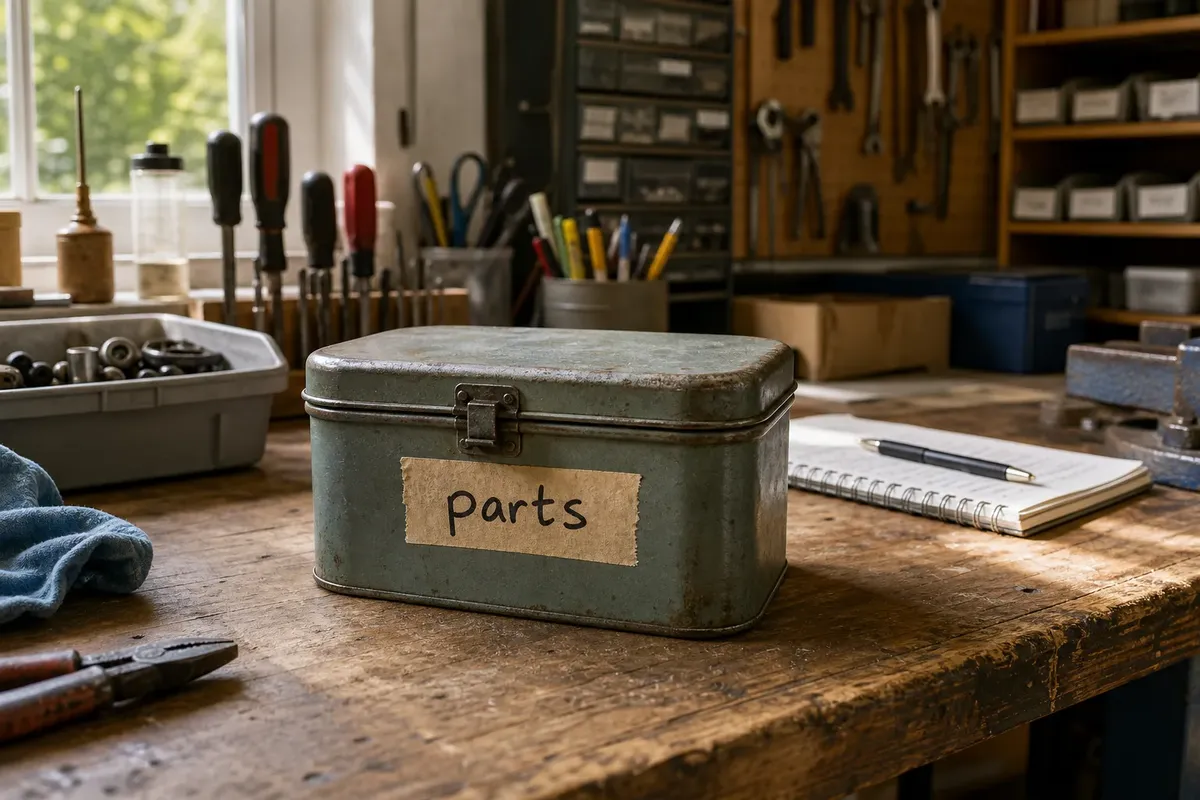
Labels can be incomplete, outdated, ambiguous, or detached from the context that gave them meaning. A symbol may follow a local convention, while a short phrase such as “parts” could describe what belongs inside a tin or simply name the tin’s owner’s filing system.
Even clear wording may answer a different question from the one you have. “Recyclable” describes a material or intended route in some systems; it does not by itself tell you what a particular collection accepts. A product name may identify a model, not explain how to operate it.
This distinction matters most when a label is being asked to do more than it says. Do not turn a printed noun into proof of ownership, a disposal rule, or permission to handle something.
How do labels change as objects are reused?
An object can outlive the purpose its label describes. A jar made for food might later hold screws, and a box marked “archive” might be used to store packing material. In those cases, the label can preserve an earlier intention while the current contents and use have changed.
Labels may also travel with an object after a repair, hand-me-down, or change of location. A workshop tag on a part found in a household drawer could refer to its former setting, not its present role. The label is evidence of a description or decision at some point; without more context, it cannot date that decision or identify who made it.
What should you check when a label leaves questions?
Check the source and scope of the wording before relying on it. For a product, the maker’s instructions may clarify operation; for disposal, the local service’s guidance matters; for an object in a shared workplace, the responsible person may know whether a label is current.
- Source: If the label names a maker or organization, check that source’s current instructions; if no source is identifiable, treat the wording as unverified and ask the responsible person.
- Scope: If the words refer to one component, do not apply them to the whole object; if the scope is unclear, seek a fuller description before acting.
- Date or condition: If the label appears damaged, covered, or inconsistent with a recent change, do not rely on it alone; look for an updated instruction or leave the decision to someone responsible.
- Local rule: If the label concerns disposal or access, check the relevant local or organizational guidance; if that guidance differs, follow the applicable current direction rather than the object’s generic wording.
- Permission: If ownership or authorization is uncertain, do not infer permission from a label; ask the owner or responsible staff member, and leave the object untouched until clarified.
- Conflict: If the wording clashes with a visible control or warning, do not force, open, or activate the object; consult its instructions or ask a qualified person where safety is involved.
How should you interpret a label in a specific situation?
Does a material label decide how an item is recycled?
No. A material mark may identify what something is made from, but collection rules can vary by locality and by component. Check the local waste service’s instructions, especially when a lid, lining, or attached part may be handled separately.
What does a label prove about an object’s past?
It establishes that the wording is present now, not necessarily when it was applied or whether it remained accurate. Treat it as a clue to a past description, and seek records or a knowledgeable source if provenance matters.
Should you follow a label that conflicts with the object?
Do not resolve a conflict by guessing or applying force. Check the maker’s instructions or ask the person responsible; if the issue involves a hazard, defer to a qualified professional.
Can a label tell you who owns an object?
A name or department may indicate an association, but it does not necessarily establish current ownership or permission to use the item. Confirm with the relevant person or organization before taking or altering it.
What does a careful reading look like in practice?
Imagine you find a small tin on a shared workbench. Its handwritten label says “parts,” it has a hinged lid, and the workbench belongs to a repair room; the starting facts are only those visible details, not knowledge of the tin’s contents or owner.
First, read “parts” as a label claim rather than proof of contents. Next, note that the lid and tin could hold small items, but that shape does not identify what is inside. Then treat the repair-room setting as a plausible clue, not a record of ownership. Since permission and contents remain unknown, the resulting decision is to leave the tin closed and ask the person responsible; the tradeoff is a slower answer in exchange for avoiding an unsupported assumption.
It is not worth cataloging every scratch or inventing a story for an ordinary label. Spend attention where the wording affects a real decision: what an item is, how it should be handled, or whether you may use it. The useful question is not simply what an object label means, but what its source and scope allow you to conclude.
Nearby questions

Why Honeycomb Cells Settle into Hexagons
Why honeycomb cells settle into hexagons involves geometry and bee construction. Learn what shared walls explain—and…

Borrowed Words: Keep the Spelling, Adapt the Sound
Borrowed words need not force a choice between sound and spelling. Keep a recognizable written form,…