Why Honeycomb Cells Settle into Hexagons
Why honeycomb cells settle into hexagons involves geometry and bee construction. Learn what shared walls explain—and what a finished comb cannot tell you.
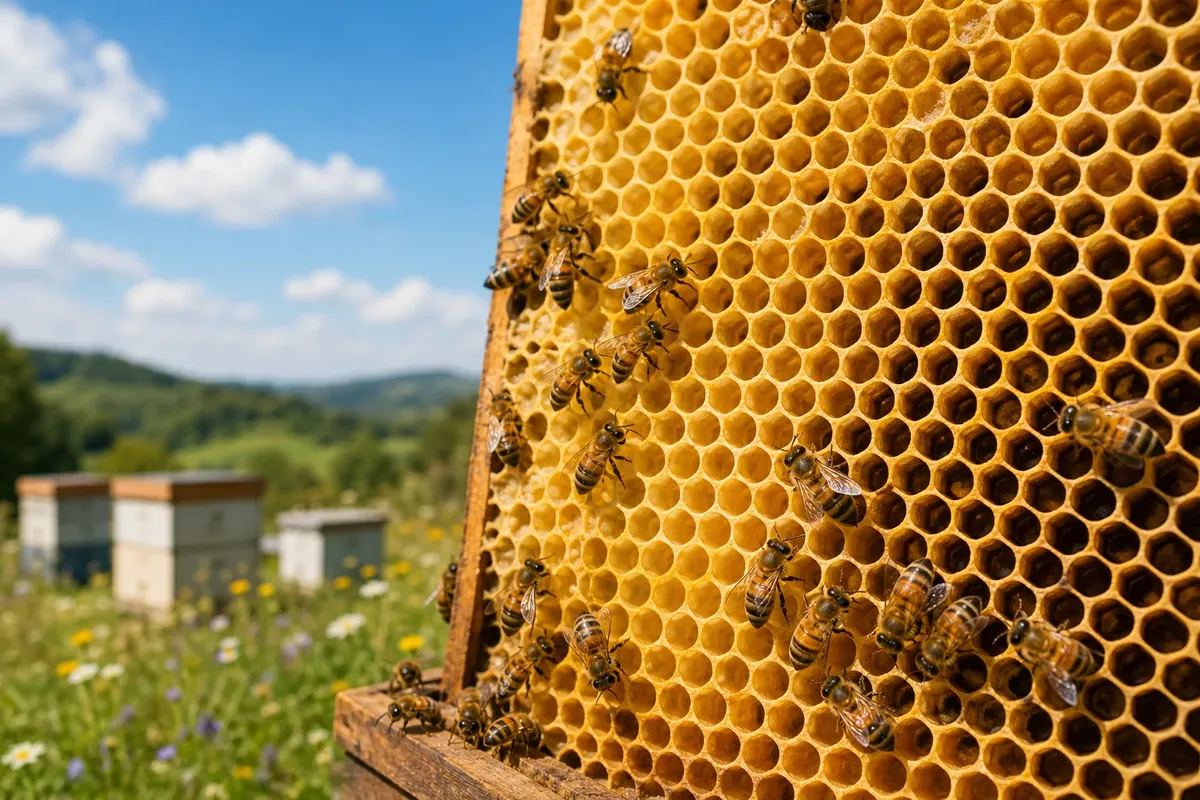
Why honeycomb cells settle into hexagons is a question about both geometry and construction. A finished comb shows cells sharing boundaries, but its appearance alone cannot establish exactly how each wall took shape.
Why do honeycomb hexagons fit together?
Regular hexagons cover a flat surface without gaps or overlaps. In a comb, neighboring cells share walls, so one boundary can serve both cells.
Hexagons are not the only shapes that tile a plane: squares and equilateral triangles do, too. The geometry explains how a hexagonal pattern can fit together, not why bees build it in that form.
What can we say about bees and wax?
Bees add wax among existing cells, where neighboring walls constrain the space available for new boundaries. They shape and join wax during construction, producing a connected structure that can show a broadly hexagonal pattern.
That description does not settle the detailed cause of every edge or junction. In particular, a finished comb does not by itself show that pliable wax yielded or settled at wall intersections to create the hexagons. Treating that proposed mechanism as established would go beyond what the visible pattern supports.
Geometry describes how the completed cells can fit together. Bee construction describes the setting in which walls are added and joined. Neither observation alone identifies a single exclusive cause for the shape.
What should you look for in a real comb?
Imagine an invented situation: a patch has a closed center of twelve cells and an unfinished edge where three new cell outlines are being added. You note which boundaries are shared, then compare the enclosed cells with the exposed outlines. The expected observation is a connected center with broadly six-sided cells and less regular outlines at the unfinished edge; that supports describing the pattern as hexagonal, not claiming how every junction formed.
- Shared boundaries: If adjacent cells visibly use the same wall, describe it as shared; if the edge is open, call it unfinished rather than a completed shared wall.
- Cell outlines: If most enclosed cells have six sides, describe the broad pattern as hexagonal; if the outlines vary substantially, mention the variation rather than calling each cell regular.
- Position: If a cell is surrounded by neighbors, compare its outline with nearby enclosed cells; if it is on an edge, note that exposed position before comparing its shape.
- Wall junctions: If walls meet visibly, describe the junction as connected; if the meeting is obscured or incomplete, avoid inferring its construction from appearance.
- Wax claims: If discussing material, say bees shape and join wax as they build; if proposing that wax behavior caused a particular shape, qualify it as a possible account rather than a visible fact.
- Construction claims: If describing growth, note that bees build beside existing cells; if the comb alone is your evidence, do not infer the exact sequence of building from its finished form.
- Cause claims: If geometry, neighboring cells, and material behavior could all be relevant, distinguish those observations; if the evidence does not isolate one cause, do not present one as the complete explanation.
What do readers ask about honeycomb hexagons?
Do bees deliberately draw perfect hexagons?
A finished pattern does not show that each bee sketches a complete outline before building. Construction among existing cells can be described without claiming to know what an individual bee plans.
Are hexagons the only shapes that tile a surface?
No. Squares and equilateral triangles also cover a flat surface without gaps. Hexagons are one possible tiling shape, and comb cells form a connected structure with shared walls.
Does wax alone create the hexagonal shape?
The finished comb does not establish wax as the sole cause. Bees shape and join wax among existing cells, but the appearance of a junction cannot verify a specific material mechanism.
Are all honeycomb cells exact regular hexagons?
No. Cell outlines can vary, especially at exposed edges or where sections meet. “Hexagonal” describes the broad pattern, not a claim that every cell matches a geometric template.
What is not worth explaining away?
It is not useful to demand perfect six-sided cells before calling a comb broadly hexagonal. It is equally unhelpful to turn a plausible account of wax behavior into a proven explanation for each wall junction.
Why honeycomb cells settle into hexagons has a careful answer: the pattern is geometrically compatible with shared walls, and bees build by shaping and joining wax among existing cells. A comb lets you describe the result; it does not, by itself, reveal the precise cause of every edge.
Nearby questions

Borrowed Words: Keep the Spelling, Adapt the Sound
Borrowed words need not force a choice between sound and spelling. Keep a recognizable written form,…

Paper Clip History Before the Desk Drawer
Paper clip history traces the shift from ties and pierced pages to a removable wire fastener,…