The Message Hidden in a Medieval Coat of Arms
Read a medieval coat of arms without treating every shape as a fixed code: identify its parts, compare records and separate evidence from guesswork.
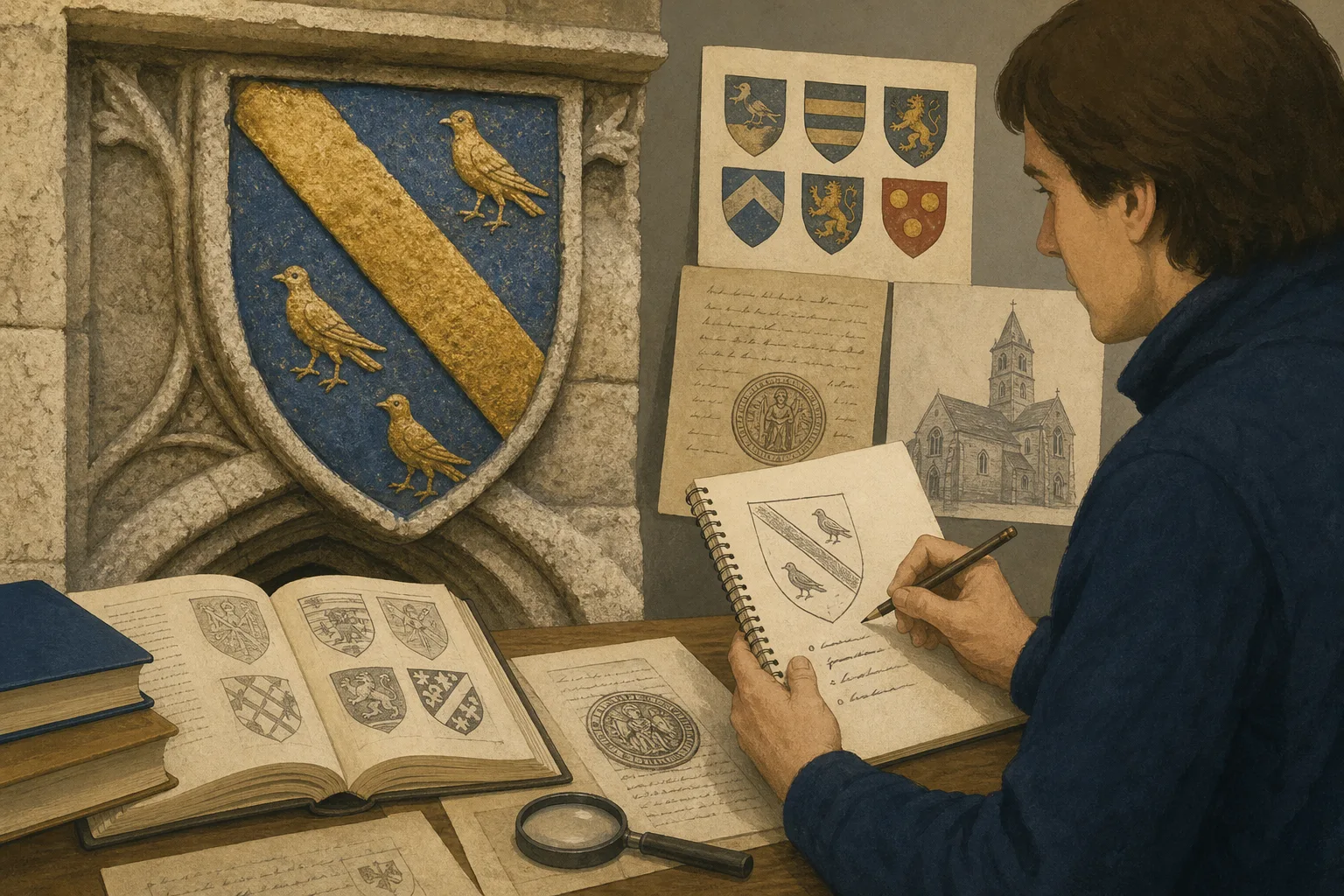
The commonest mistake when reading a medieval coat of arms is to translate every shape into a fixed symbolic message. The cost is a confident story that may obscure what the object can actually tell you. Start with the visible design, then check its setting and the records connected with it.
A coat of arms was an identifying design used by people and institutions, and displayed on objects including shields, seals and monuments. Its figures and colours helped distinguish one design from another; they did not form a universal dictionary. A lion alone cannot establish that its bearer meant courage, and a red field cannot settle why that colour was chosen.
Describe a medieval coat of arms before interpreting it
Begin in plain language. Is the shield a single colour, divided into areas or covered with repeated figures? Is the main creature upright or walking? Does a broad band cross the shield, or does a pattern cover the field?
This simple inventory keeps a familiar shape from acquiring an assumed meaning. A bird might be an eagle, falcon or another heraldic bird. Wear, damage or later restoration can make a precise identification impossible. Record what is visible before deciding what to call it.
Look at the object, not only a modern drawing or caption. A label may offer a conventional description; an old carving may have lost details, and a later artist may have simplified them. Note whether the arms appear on a tomb, seal, manuscript or building. A name or document linked to the object may help identify the design.
Separate the field, divisions and charges
The field is the shield’s background. A division separates it into areas. An ordinary is a prominent geometric charge, such as a broad horizontal band or diagonal stripe. A charge is a figure placed on the field or on another charge: an animal, object, plant or smaller shape.
These terms describe structure, not hidden messages. A shield divided into two colours does not, by itself, depict rival families. A diagonal band need not represent a road or river. Establish how the design is arranged before asking why it was chosen.
A blazon is the formal verbal description of a coat of arms. It generally sets out the field, then describes the charges and their positions. It can distinguish one arrangement from another, but it does not, by itself, explain the bearer’s motives.
Read heraldic colours as visual choices first
Heraldic descriptions use conventional colour terms. Gold is or, silver or white is argent, red is gules, blue is azure, black is sable and green is vert. These terms help describe designs consistently. An object’s original colours may be difficult to establish if it has faded, darkened or been repainted.
Colour can distinguish one design from another, but it is not a dependable key to a fixed moral quality. Heraldic descriptions distinguish between metals, such as or and argent, and colours, such as gules and azure. Conventions govern how these categories are arranged, with exceptions. They describe heraldic practice, not a secret vocabulary.
Do not assume that a later association was shared by a medieval bearer. Red may suggest courage to a modern reader, but the colour alone cannot show that this was the reason for choosing it. A colour might have been inherited, selected for visibility or connected to a person or place. Without evidence tied to the particular arms, leave the explanation open.
Notice how the shapes work together
Arrangement can tell you more than an isolated figure. Repeated charges create a pattern; a central animal may dominate a plain field; two devices placed together may prompt questions about inheritance or affiliation. These are leads to check, not conclusions to draw from the image alone.
Scale, direction and position matter. A lion rampant, shown upright, differs from a lion passant, shown walking. A small mark added to distinguish one branch of a family may look decorative to a casual viewer. It can help identify the arms without carrying a dramatic story.
Say you encounter a worn stone shield above a church doorway. In this invented situation, you can make out a blue field, a gold diagonal band and three small birds, but cannot tell what kind. First, write down those visible features without naming the birds more precisely. Next, compare the description with a local catalogue and a documented seal, recording whether each source gives a matching design and a name. If both link the design to the same family and the dates and setting are plausible, record the attribution as supported but still checkable; if neither provides that link, retain the literal description. The result is a modest identification—or a clear account of what remains unknown—rather than a claim based on resemblance alone.
Check the evidence before assigning a story
Attribution is where interpretation often goes astray. Arms may be associated with a family, office, institution or individual, but an object could have been made or altered later. A church memorial, for instance, may display arms chosen by descendants rather than those used by the person it commemorates.
Useful evidence can include dated seals, manuscripts, inscriptions, family records and reliable local catalogues. Compare occurrences when possible. A design repeatedly associated with the same name offers grounds for a stronger identification than an unlabelled carving. A close visual resemblance is a lead, not proof.
Ask when the object was made and whether its setting changed. A later copy may reproduce an earlier design imperfectly. A carved panel may have been moved from another building; restoration can also alter colours or sharpen unclear edges. These possibilities affect how firmly you can describe what the object shows.
Why does a heraldic symbol resist a simple translation?
Did every heraldic animal have one fixed meaning?
No. Animals could be selected for family associations, appearance, a name, a local connection or a reason that is no longer known. The figure alone cannot establish which explanation applies.
Can colour reveal what a family believed?
Not reliably on its own. Colour helped distinguish designs, while a particular choice might have personal or inherited significance. A claim about belief needs evidence beyond the colour itself.
What does a stripe across a shield mean?
It may be an ordinary, a prominent geometric charge, rather than a literal object or message. Its placement helps describe the design but does not automatically disclose why it was chosen.
How can I identify a coat of arms?
Describe the field, colours, divisions, charges and positions, then compare that description with reliable records or catalogues. Check the object’s date and setting, and treat a close match as tentative unless other evidence supports it.
Use a cautious order when reading a coat of arms
Work through the evidence in sequence. Each observation should determine what to check next, rather than prompt an immediate symbolic explanation.
- Visible design: Check the field, colours, divisions, figures and positions. If these are clear, record them; if a detail is obscured, mark it as uncertain and use a broader description.
- Condition: Check for wear, damage, repainting or restoration. If the surface appears altered, do not treat its present colour or outline as original; if no alteration is apparent, still record that the appearance alone does not establish its age.
- Object setting: Check whether the arms appear on a tomb, seal, manuscript or building. If the setting is documented, use it as a clue for further checking; if the object may have been moved, leave its original association open.
- Heraldic description: Check which charges and arrangements can be named confidently. If a figure is clear, describe it precisely; if it is ambiguous, use a broader term such as “bird”.
- Attribution: Check for a name or matching design in dated records, inscriptions or a reliable catalogue. If relevant evidence supports the link, describe the attribution with care; if there is only an unlabelled resemblance, keep it tentative.
- Symbolic interpretation: Check whether a proposed meaning has evidence tied to this bearer and object. If it does, distinguish the evidence from the interpretation; if it does not, describe the design without claiming a hidden message.
This order prevents an attractive story from deciding what the picture must show. “A bird, perhaps an eagle” is a more useful starting point than a precise identification based on a damaged outline.
Let the emblem remain more than a code
A medieval coat of arms is a designed object, not a sentence whose every element can be translated. Its parts distinguish designs, and their arrangement may preserve clues about inheritance, affiliation or display. Meaning depends on the bearer, date and setting; the available evidence may not answer every question.
If you are asking what message is hidden in a medieval coat of arms, begin with the visible design, establish how its parts relate, and check the historical context. Keep documented identification separate from an appealing interpretation. For a disputed attribution or specialist blazon, consult a heraldic authority or a qualified historian; a careful description remains useful even when the story behind it does not survive.