Why Soap Lifts Grease from a Plate
Why soap lifts grease from a plate: see how its molecules help water loosen oily residue, carry it away and leave a cleaner surface after rinsing.
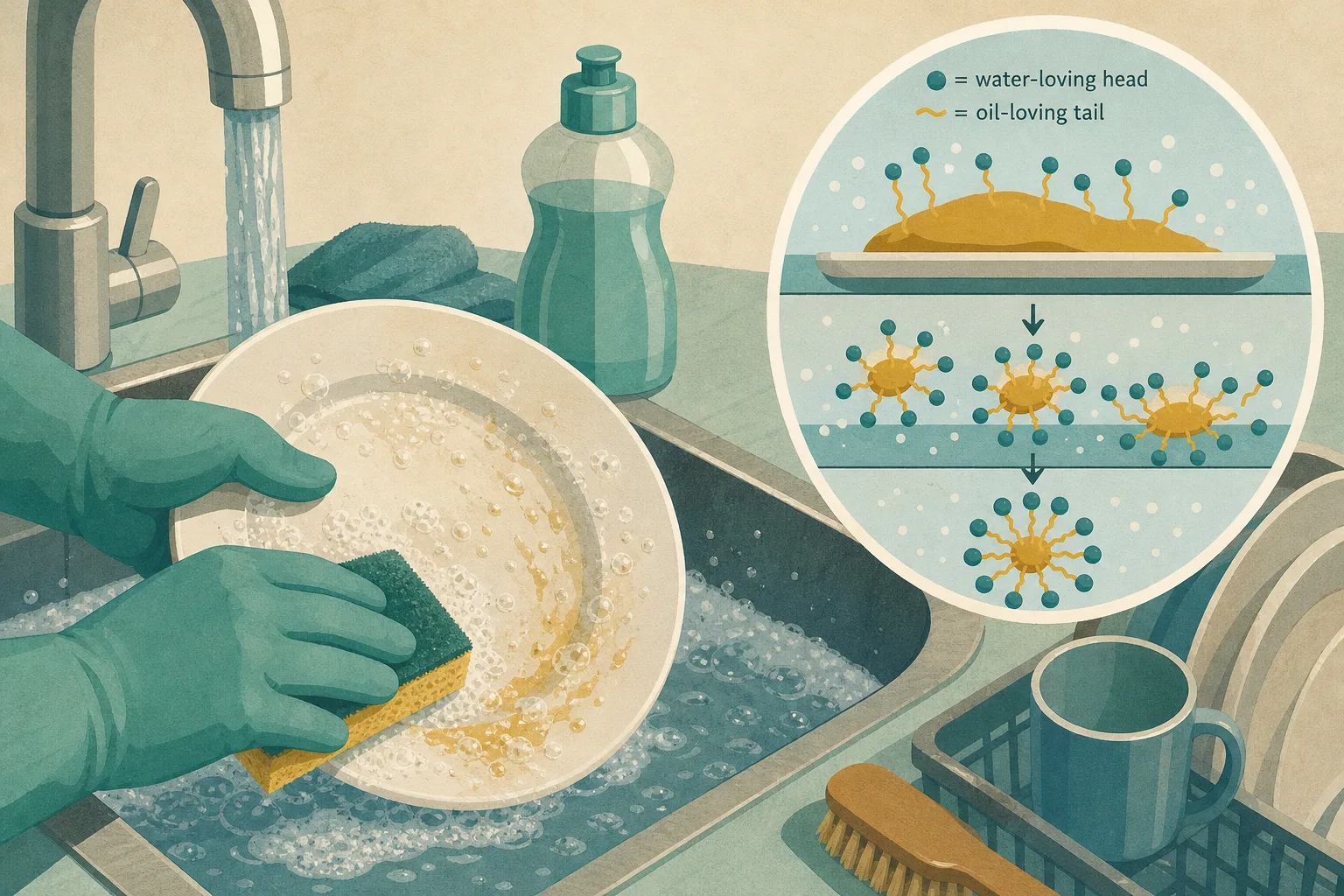
The common mistake with a greasy plate is to rinse it with water and expect the slickness to disappear. Water beads and runs off much of the oil instead, leaving a film that smears onto a cloth or the next dish. Why soap lifts grease from a plate comes down to molecules that can interact with both water and oil.
Water and grease do not readily mix
Water molecules attract one another strongly. Oil molecules, by contrast, are largely non-polar: their electrical charge is distributed in a way that gives water little reason to mingle with them. Put the two together and they tend to separate, rather than form a uniform liquid.
That is why plain water can rinse away loose crumbs but struggles with a coating of cooking oil. It may push the grease around or break it into temporary patches, yet those patches can gather again on the plate. The water has not made the oil soluble; it has only moved it.
A greasy surface also resists wetting. Water tends to bead on it because the water molecules prefer contact with one another to contact with the oily layer. A rinse can therefore pass over the plate while leaving much of the residue behind.
Soap has a water-friendly end and an oil-friendly end
Soap molecules are surfactants. Each has a water-attracting part, called a hydrophilic head, and an oil-attracting part, called a hydrophobic tail. The tail is compatible with oily material; the head interacts readily with water.
At a greasy patch, soap molecules gather at the boundary between oil and water. Their tails sit in or against the grease while their heads remain in the surrounding water. This arrangement lowers the resistance at that boundary and helps water spread across the oily surface.
Soap does not dissolve grease in the same way salt dissolves in water. Instead, it helps break the grease into small droplets and keep those droplets dispersed in the wash water. The oily material is still present, but it is divided and surrounded by soap molecules, making it easier to carry away.
Micelles keep loosened oil from rejoining the plate
When enough soap is present, some molecules form tiny clusters called micelles. Their oil-friendly tails point inward, where they can associate with grease, while their water-friendly heads face outwards into the water. A greasy droplet can become enclosed or held among these molecules.
This does not mean every bit of oil is neatly packed into a perfect sphere. A dishwashing solution contains a shifting mixture of soap molecules, droplets and other materials. The useful point is simpler: soap helps keep loosened oil dispersed in water instead of letting it settle straight back onto the plate.
Rinsing then carries away water containing the suspended grease. Without enough soap, or with too little movement, oily patches may remain large enough to cling to the surface. With soap and rubbing, the residue is divided into smaller portions and lifted more effectively.
Why soap lifts grease from a plate more readily with rubbing
Soap changes the conditions at the surface, but physical action helps the process along. A sponge or cloth presses wash water against the plate, reaches around stuck-on residue and supplies friction that loosens it. Warm water can soften some fats and make them flow more readily, though warmth alone does not make oil mix with water.
Imagine a plate with a thin coating of butter after toast. If you rinse it immediately, water may run over the slick layer while leaving a smear. If you add washing-up liquid, rub the surface with a damp sponge, then rinse, soap can work at the oil-water boundary as the sponge breaks the coating into smaller patches. The expected observable result is less visible slickness and rinse water that carries away the loosened residue.
The amount of soap matters in a practical sense, but more is not automatically better. A little washing-up liquid spread through the water can provide surfactant molecules where they are needed. A heavily soiled pan may need fresh solution because grease accumulates in the wash and can redeposit on other surfaces.
Grease removal depends on the whole washing process
Several factors affect how clean a plate becomes:
- Soap: Use washing-up liquid formulated for dishes. It supplies surfactants suited to lifting common food oils.
- Contact: Let the soapy water reach the greasy area rather than rinsing the plate from a distance.
- Movement: Rub with a sponge or cloth to loosen the film and renew contact between water, soap and residue.
- Water temperature: Warm water can soften fats. Avoid water that is uncomfortably hot to handle.
- Rinsing: Use clean running water to remove the wash solution and the grease it has dispersed.
- Wash-water condition: Replace water that has become heavily oily, since it may leave residue behind.
These actions work together. Soap helps water wet the surface and disperse the oil; rubbing loosens it; rinsing removes the resulting mixture. Skip one part and the others may do less. A plate scrubbed in greasy water, for instance, can finish with a fresh coating despite the effort.
What should you know about soap and greasy dishes?
Why does water bead on an oily plate?
Water molecules attract each other more readily than they interact with the non-polar oil. The water therefore tends to bead or run across the greasy layer instead of spreading evenly over it.
Does soap make grease dissolve in water?
Not exactly. Soap helps break grease into small droplets and keeps them dispersed in the wash water, so they can be rinsed away rather than simply mixing into a clear solution.
Does hotter water always clean grease better?
Warm water can soften many fats and help them move, but temperature does not replace surfactant action or rubbing. Use a temperature that is safe to handle and suitable for the dish.
Why can a plate still feel greasy after washing?
There may have been too little soap, too little rubbing or wash water already loaded with oil. A clean rinse and fresh soapy water can remove residue that has been spread rather than lifted.
The useful distinction is loosening versus removing
Soap does not make grease vanish. It helps water reach the oily surface, helps separate residue into manageable droplets and keeps much of that material suspended long enough for rinsing to carry it away. The sponge supplies contact and friction; the clean rinse completes the job.
That is the practical answer to why soap lifts grease from a plate: its molecules bridge a gap between water and oil that neither can cross easily alone. When a plate still feels slick, the sensible fix is usually to renew the soapy water, rub the surface and rinse the loosened film away, rather than asking plain water to do chemistry it was never suited for.